Showing posts with label ghosts. Show all posts

Saturday, May 30, 2015

The Maid (2005)

I once told a friend that I found it easier to believe in the possibility of ghosts than I did in the possibility of good ghost movies, to which he replied that I was the only gullible cynic he knew.

This exchange took place during that wretched hiatus between the release of Jan de Bont’s The Haunting and the American DVD release of the revelation that was Hideo Nakata’s Ringu four years later.

Since then, the Pacific Rim film cultures have given us some of the scariest, most challenging ghost movies of all time. In the west, ghost stories are just another subgenre under the heading “Horror.” In Asia, ghost stories are taken far more seriously.

Billed as Singapore’s first “home grown” horror movie, The Maid is an intriguing blend of ghost movie staples with superior acting and a fascinating background which will be unknown to most western viewers.

A pretty Filipina (Alessandra de Rossi) arrives in Singpore on the first day of the seventh month of the Chinese calendar, the Month of the Hungry Ghosts. She is warned by the couple in whose home she will work as a maid not to offend these spirits.

She watches Mrs. Teo (Huifang Hong) place food on the sidewalk in front of the Teo house to appease the ghosts’ appetite. She and her husband (Schucheng Chen) burn paper offerings and scold Rosa when she innocently tries to sweep away the ashes. It’s something you don’t do, like look a ghost in the face, stay out after 5:00 in the evening, or respond when someone calls your name from behind you.

The Teos work with a Chinese opera company, and when Rosa attends one of the performances she sits on the front row. Soon a pale, wizened man forces her to move as she is sitting in his wife’s seat. He’s a ghost and so, Rosa discovers, is everyone sitting on the front row with her. The seats are reserved for spirits.

These episodes are unnerving for Rosa, but her encounters with the Hungry Ghosts soon turn much nastier. She has befriended Ah Soon (Benny Soh), her master’s and mistress’ retarded, adult son. In a quartet of outstanding performances, Soh’s is chilling in a way you almost hate to admit. So brilliantly does he recreate the facial expressions, movements and mannerisms of a mentally challanged man, he makes you uncomfortable when you watch him. Rarely has that feeling of uneasy voyeurism you felt the first time you watched Freaks been generated so convincingly from the screen.

As she and Ah Soon play, Rosa notices that the unfortunate man insists on calling her Esther, the name of the Teo’s last maid, the one they tell her met a man a ran away. When? Oh, about this time last year.

But if Esther ran away, why does she keep turning up around the house?

Writer/director Kelvin Tong uses many of the standard tricks of the spookshow trade, but he uses them so well most of them seem new. If he borrows a little obviously from popular western films of recent years, I suspect he’s only finding his way.

And, to be honest, the film’s producer has admitted that he was aiming at making an “international” film, i.e., one that would appeal to a western audience. But western audiences don’t respond so favorably to the new Asian horror movies because they ape the American product. We like them for their different approaches to the material to which we’ve grown so bored from the overuse of cliches. In other words, we like best what’s most Asian in these films.

I think Tong is capable of some pretty eerie stuff in future, if he chooses to stick with horror for a few more movies.

The Maid isn’t the most frightening picture that’s come out of the east, nor is it the most original, but it promises much and uses its background well, introducing us to customs and beliefs we haven’t been exposed to before. That’s more than what we expect from a good horror movie—it’s what we should be able to expect from a good movie, period.

Sunday, May 10, 2015

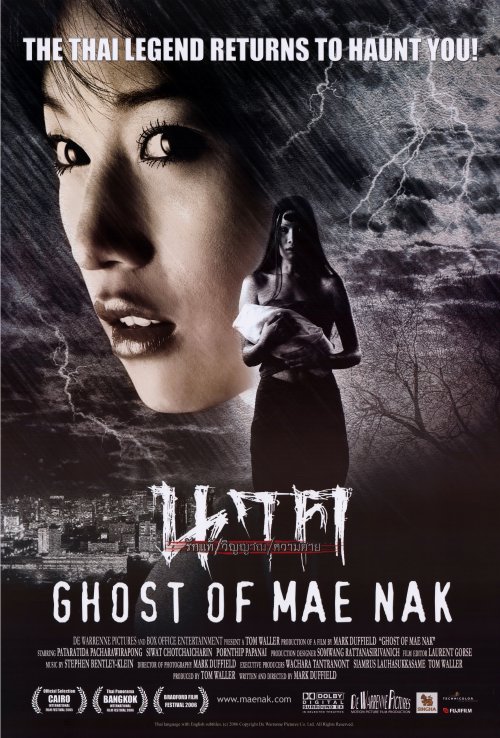
The Ghost of Mae Nak (2005)

The legend of Mae Nak’s ghost has served as the basis for films in Thailand over 20 times, and this ghost story seems to be as popular there as the one about the vanishing hitchhiker is in America. It's the story of young newlyweds who find the early days of their marriage disrupted by a vengeful spirit.

Mak (Siwat Chotchaicharin) loves Nak (Pataratida Pacharawirapong), and vice versa. They chant this refrain to each other frequently, but it doesn’t play as cutesy as it sounds like it would because they really seem to mean it. The film tends to play just a notch or two beyond the point of reality for western viewers—reactions are a little too big and some of the dialogue seems to be delivered too broadly, but this may be the norm in Thai cinema, as it is in Bollywood films.

We meet the two a week before their wedding. They’ve seen an ad in the newspaper for a house for sale and they meet with the real estate agent, Mr. Angel (Meesak Nakarat), who tells them the house is over 100 years old. The lovers like and trust Mr. Angel, but then they trust their lawyer, too. Obviously, folks in Bangkok are a little different than we are in this country.

As they inspect the house, Mak has a brief but frightening encounter with what is surely a ghost. Her appearance is preceded by the sound of a breathy sigh, like Joan Jett singing “Crimson and Clover.” Worse yet, Mak’s been having nightmares about this same vaporous woman. The waking sight of her unnerves him, but not to the point of disappointing Nak, who really wants to buy the place.

They buy it, fix it up, and move in.

After the wedding takes place, eerie visitations and frightening nightmares increase, but now Nak is experiencing them as well. She hears the name “Mae Nak” and mentions it to her grandmother. Granny tells her Mae Nak’s back story.

Around 100 years ago, a couple who loved each other very much married. Their names were Mak and Nak. Mak went away to war and was seriously wounded. Some monks nursed him back to health and he returned to his home. While he was gone, Nak (Porntip Papanai) gave birth to their child. They were happy together, but Mak couldn’t understand why his old friends avoided visiting with him at home.

I’ve probably already told you too much, so I’ll only say from this point on in the film writer/director Mark Duffield picks up the pace considerably as the ghost woman goes after everyone in the modern couple’s life who does anything to come between them. Duffield even tosses in a couple a gruesome death scenes that should bring a cold smile to the lips of even the most jaded western gorehounds.

There’s a nice scene in an operating room that is at once both surprising and silly, but it works because we’ve become used to the slightly overwrought feel of the entire film. I could do without the head-beating of having both sets of lovers bear the same names, but the film isn’t going for subtlety.

There are no overwhelming scares in the movie, but there is a building tension. If the first half of the picture intrigues with its moments of everyday life in an exotic setting, the second half ladles on a creepy disquiet that culminates in a kick ass ending you won’t see coming.

“The Ghost of Mae Nak” is a nifty ghost story that may burrow deepest under the skin of people who think that ghosts, and ghost stories, are silly. It asks, along with Poe, “Is all that we see or seem / But a dream within a dream?” and answers, “I’ll let you know when I wake up. If I wake up.”

Tuesday, June 25, 2013

Phone, aka Pon (2002)


This effective ghost story from South Korea approaches overkill but doesn’t go over the line. It also presents one of the best creep-out performances from a child, ever.  

Ji-won (Ji-won Ha) is a reporter who has just completed a series of articles about a ring of pedophiles. A man who is outraged by the stories (we assume because he’s close to, if not a member of, the ring) keeps bombarding her with threatening phone calls. Her best friend Ho-jeong (Yu-mi Kim) invites her to move temporarily into the new house Ho-j has just finished decorating and in which she and her husband Chang-hoon (Woo-jae Choi) will soon take up residence. Ji-w accepts, hoping to hide from her tormentor. 

But after the move, something odd happens. Ho-j’s young daughter Yeong-ju (Seo-woo Eun) answers a call on “Aunt Ji-won’s” mobile phone. Whatever she hears shapes her face into a mask of terror and she begins screaming.  After that, she fluctuates between happy little Yeong-ju and something else, something that develops a creepy, sexually charged affection for her father and bitter jealousy for her mother. Note here that the Yeong-ju can’t be more than six years old. 

As the air grows thicker and the story moves toward its grotesque finale, we learn that Ji-won’s mobile phone as been assigned a number that was given previously to a couple of people who died violently. There seems to be something in the number 6644. There are the ghost of the teen Jin-hie (Ji-yeon Choi), a girl who seeks vengeance because of a sordid, failed love affair; lots of rainy nights, and enough sudden apparitions to satisfy the most fervent lover of K-horror. The scene when Jin-hie succeeds in possessing Yeong-ju is terrifying not only within the context of the story but also because of the intensity of young Seo-woo Eun. You won’t believe what you’re seeing. 

The film was written and directed by Byeong-ki Ahn, and it is a masterful piece of work. If you’re not already familiar with the South Korean horror renaissance of the 1990s-early 2000s, this is a good place to start getting acquainted.

Tuesday, June 18, 2013

House Hunting (2013)

It’s a tale of two families—Hays and Thomson.  Charlie Hays (Marc Singer) has his hands full with a new(ish) wife, Susan (Hayley DuMond), and a teen daughter, Emmy (Janey Gioiosa), who hates her.  Biological mom ran off with another man.  Charlie works for a company (bank? investment firm?) that foreclosed on a farm, house and 70 acres, and Dad is taking the family out to look at it, thinking he may want to buy. 

Other family.   Don Thomson (Art LeFleur) is a grouch who is being dragged from one open house to another by his wife Leslie (Victoria Vance) and his teen son Jason (Paul McGill).  As he stands, smoking, in front of a suburban mediocrity that looks pretty much like the one they just left, a man wearing one of those hideous arctic hats with earflaps—mukluks for the head—and leading a dog on a leash approaches him.  They agree that the neighborhood sucks and the man gives Don a card with an address on it, an address for the perfect place, a farm on 70 acres. 

The Hays family arrives at the house first, but they are immediately followed by the Thomsons.  The two men appraise each other as rivals for the property, but neither of them goes into the building beyond the foyer, and then they decide to leave. 

As Charlie drives away from the house, a young woman rushes from the woods in front of his car.  He smacks into a tree, but gets out and goes to her, sees that he didn’t hit her but that still she is covered in blood. 

Don pulls up behind him.  Since Charlie’s car is too scrunched up to drive, Don offers to take him and the young woman back to the house so they can call for help.  The young woman, Hanna (Rebekah Kennedy), tries to flee in fear.  When they ask her why, the families discover that she has recently had her tongue cut out. 

All seven people cram into Don’s car and head back to the highway, but end up every time they try back at the house.  Which apparently doesn’t want them to leave.  In the pantry, they find seven cans of beef stew.  They think they see the man with the hat walking his dog, but when they shout at him to stop, he disappears. 

A month later, a month of no communication with the outside world, there continue to be seven cans of stew on the shelf every day. 

Until the day there are only six. 

The film was written and directed by Eric Hurt, who plays around nicely with the devices of the traditional ghost story.  What he does best is suggest a meaning for what the families are going through while keeping a definitive explanation just out of reach.  The best ghost stories don’t tell you what you you need to know in order to make the oddness understandable.  That’s not the way ghosts work in real life (so they tell me).  It’s said that the difference between a fictional ghost story and a real one is that the fictional haunting makes sense and the actual one doesn’t.  Hauntings don’t always happen out of a need for spectral revenge, or for the completion of some unfinished business. 

If you need an explanation in this case, imdb says that the film’s script is loosely based on Sartre’s play No Exit.  You can extrapolate a meaning from that. 

The acting is fine and production values are good.  There’s not a lot to be said yay or nay about either thing.  The real pleasure comes from watching a contemporary ghost movie that looks further back for inspiration than last week’s episode of some ghost hunting show on cable TV.

Friday, March 22, 2013

100 Ghost Street: The Return of Richard Speck (2012)


Whew—this one’s so derivative it could have been shot with a Xerox machine. It’s yet another:

·        Tale of an overnight ghost hunt in a haunted location

·        Group of numb-nuts young adults who think they can strike it rich by taping their effort to capture a ghost in the camera

·        Collection of things that go terribly wrong

·        Series of deaths as we count down the crew members who get bumped off in desperately unimaginative ways

·        Poorly written, poorly directed rip-off of Paranormal Activity with a soupcon of Blair Witch tossed in for, hell, I don’t know why. 

This motley crew and onscreen talent go to the student dorm where Richard Speck tortured, raped and murdered seven student nurses on the night of July 13, 1966. That’s true, of course—you can find the details easily enough. How you feel about taking such a horrific crime and turning it into such lame entertainment is your business. 

So anyway, seven of the eight team members lock themselves into the building, they say to keep vagrants from coming inside. It makes sense, except for the fact that there is only one key to let them out again. When the director of the project gets sliced in half (why and how we don’t know—Speck didn’t hack on guys) and the key is in his pocket, we realize just how stupid having only one key is. 

Okay, one gal gets ghost raped and murdered, one guy is hanged, one gets chewed up in a drain pipe, and the others get killed in ways that are as forgettable as the characters themselves. Believe me, life is too short to memorize details from movies like this. 

The film we see is what was left behind when the ghost hunters were taken up to that Haunted Mansion in the sky, presented to us courtesy of the Illinois Police Department. Say what? We get this credit at the beginning of the film and since it’s a pretty good guess that there is no “Illinois Police Department” the filmmakers waste no time in shooting the this-is-real-folks-it-really-is in the found footage. 

There are no actor or writer or director credits but the cast is made up of Jennifer Robyn Jacobs, Jim Shipley, Tony Besson, Jackie Moore, Hayley Derryberry, Adam LaFramboise, Mike Holley, Chance Harlem, Jr., and the unseen Nancy Leopardi and Steve Mencich as ghost voices.  Leopardi wrote and Martin Andersen directed.  

It’s all sadly lacking in everything  it shouldn’t be lacking in, and brings nothing new to the party to make up for it. This is the kind of movie that having something else to do for 90 minutes was made for.