It is a solid “B” picture that would have found its home on the Syfy Channel if Samuel L. Jackson hadn’t fallen in love with the title. Oh, the title should be spoken with a pause after the first word, and then the last three added as an afterthought.
And yes, Snakes . . . on a Plane is, if you love this kind of silliness as much as you should, more fun than any of summer 2006’s over-produced and over-long blockbusters. Just don’t ask it to make sense. Director David R. Ellis (Final Destination 2, Cellular) made a career out of turning highly implausible material into amusing entertainments. If SoaP doesn’t earn him a place in the “B” Movie Hall of Fame, I’m turning in my membership card.
A surfer named Sean (Nathan Phillips) inadvertently witnesses a mob killing in Hawaii and is saved from getting killed himself by FBI agent Nelville Flynn (Jackson). Flynn has to take his witness to L.A. and the mob boss whose butt is about to go in the wringer decides to kill agent and witness while they’re in the air.
And yes, he attempts this by sneaking 300 venomous snakes onto the plane, in a container with a time lock on its door. When the reptiles are released, ending up even in an air-sick bag to spring out and latch onto some poor woman’s tongue, passengers and crew, led by feisty flight attendant Julianna Margulies, must band together and protect themselves from Many Pythons’ Flying Circus.
Is the motivation for this inanity set up for us? No. Would anyone do this when he could so much more easily plant a bomb on the plane? No. If he'd seen Red Eye, wouldn’t the killer know that he could put an assassin on the plane? Sure he would.
Look, I know that one of the mottoes of “B” film making is “Don’t explain, just keep walking,” but I would have liked for this snake schtick to have been set up better. Maybe we could have been told that the killer loves gadgets and complicated death traps. But does any of it matter? No, not if you can suspend disbelief for 106 minutes. If you can’t, go watch another movie.
Jackson doesn’t bring anything to his role but an obvious desire to play it. The story is, if you want to believe it—I think it’s part of the hype—that a web fan suggested a particular line of dialogue for Jackson, one with a double use of a word which Jackson uses a lot. When the line was delivered on screen, my audience broke into cheers and applause. Not bad for, “That’s it. I want these muthafuckin’ snakes off this muthfuckin’ plane.”
The rest of the cast is suitably energetic and the CGI snakes would look real if they were displayed from angles that didn’t scream out that the shot was faked. That also takes something away from the film’s shock value, but I suspect that if the attacks looked uncomfortably real, no one would be able to stand it. As it is, some of the places people get bit will make you, well, squirm. SoaP is good old-fashioned ghastly, dirty, horror comics fun—low down high concept.
Fangs for everything, guys. But my guess now is that every rip off picture that tries to imitate it will bite.
Come on, you know you awaited the opening of this picture either smacking you lips in anticipation or lamenting the fall of western civilization. Sure, like Oedipus Rex is the model of dramatic good taste and restraint.
Sunday, May 17, 2015
Sunday, May 10, 2015
Freaks (1932)
Freaks was first released 80 years ago. I think I’ve avoided
giving away the movie’s biggest surprise, but there are a few fairly
insignificant spoilers ahead.
Freaks is a movie that has to be seen either more than once, or not at all. It generates a kaleidoscope of reactions when seen for the first time, and it’s impossible to sort them all out with a single viewing, which will overwhelm you emotionally—but it takes repeated visits to this surreal masterpiece to determine an intellectual response.
It’s a movie that’s rich with anecdotes. One has Irving Thalberg, the film’s uncredited producer, telling director Tod Browning that he wanted to make the horror movie to end all horror movies, and then saying, when he saw the finished product, “Well, I asked for it and I got it.”
One story has it that F. Scott Fitzgerald, who was under contract as a writer at MGM when the picture was made, bolted from the studio commissary and threw-up when the unusual cast came in for lunch. Another version has it that Fitzgerald felt more at ease with the cast of Freaks than he did with the studio big shots and so sat with them and lunched at their table.
Some say that Tod Browning exploited the cast (only Olga Roderick, the Bearded Lady, went on record later as saying she regretted her participation in the production) while others claim that Browning, a former circus and sideshow man himself, befriended the performers and set them up for life by turning them into international celebrities.
One thing is certain: no other Hollywood film has ever generated legends like these.
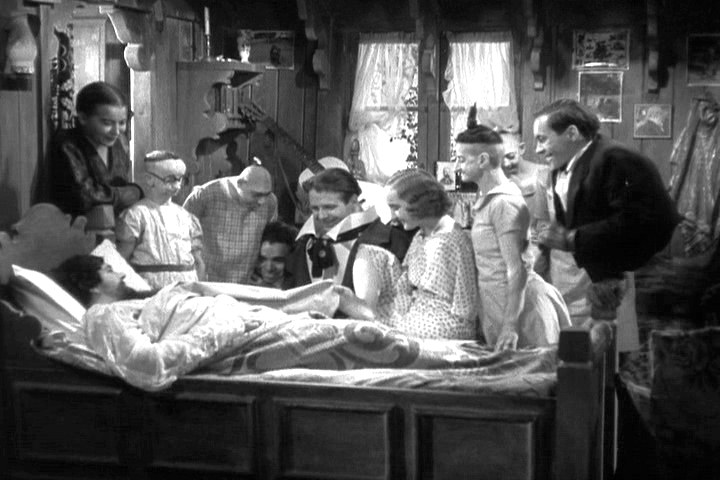
As the story opens, we are moving slowly through a sideshow. The indoor talker, who bears a striking resemblance to Tod Browning, begins to tell his audience the back story of the show’s most unusual attraction. He and his audience gather around the top of a walled pit from the interior of which a light is shining up. Then we slip into the past …
A well-tailored dwarf named Hans (Harry Earles, who had worked with Browning in the silent version of The Unholy Three) is engaged to Frieda, another dwarf (Daisy Earles, Harry’s sister in real life). Despite his betrothal to Frieda, Hans is smitten by Cleopatra, the circus’ star aerialist (Olga Baclanova). Cleopatra encourages the little man’s attentions because he is willing to loan her money and buy her presents.
Cleo’s casual cruelty is the talk of the circus. Everyone knows that she is playing Hans for a sucker except Hans, who continues to harbor the delusion that she likes him.
Unknown to Hans, Cleo is actually romantically involved with Hercules, the strong man (Henry Victor). We first see Hercules as he wrestles a bull, the animal’s horns representing both the phallus and the traditional crown of the cuckold.
Finally, Frieda confronts Cleopatra and begs the big woman to leave Hans alone. She lets slip that Hans has inherited a fortune and we can see on Cleo’s face that she decides to change her amused encouragement of the little man to a determined attempt to woo him. She soon maneuvers Hans into a proposal, which she accepts with a plan to poison him and steal his money.
The wedding feast provides the background for the film’s most celebrated and quoted scene. Cleopatra, Hercules, the freaks and the other circus normals who have befriended them are gathered around a large table under the big top. Cleo and Hercules think the event is one huge joke, knowing as they do what they intend for Hans.
But then another dwarf stands on the table and brings a loving cup to everyone gathered. They each take a sip while chanting the words that make Cleopatra a member of their community—“Gooble gobble, we accept her, one of us.” When the loving cup is thrust toward Cleopatra she rises, the full horror of what they’re saying dawning on her. “You. Dirty. Slimy. Freaks!” she screams, silencing the crowd.
Obviously, the party is over and soon the only ones left at the table are Hercules, Cleopatra and Hans. The drunken strong man lifts Hans from his bench and puts him on Cleo’s shoulders telling the woman to give her new husband a horsey ride back to his wagon. (The movie is adapted from a short story called “Spurs” by Tod Robbins and this “horsey ride” is at the center of the original tale.)
Hans soon falls ill, but the freaks have overheard the plotting of Hercules and Cleopatra. Off screen they tell Hans what his wife and her lover are up to and one dark stormy night the freaks take their revenge.
The film ends back at the indoor sideshow. A woman looks down into the pit and screams. Then Browning shows us the nature of the freak’s revenge. I won’t go into any detail, but is it absurd? Oh yeah. Effective? You better believe it.
An overview of the plot, which is a standard morality/revenge tale, does nothing to prepare you for viewing the film. The cadre of freaks is made up of dwarfs, microcephalics (referred to in the movie as “pinheads”), Siamese twins, people who are armless and legless—and in one case, both—a bearded lady, an hermaphrodite, and persons the descriptions of whom are beyond my vocabulary.
The characters play their reaction to the sideshow performers several ways. Some of the normals abuse them. Some are casually cruel and some are deliberately so. Other normals befriend the freaks. Wallace Ford and Leila Hyams are Phroso the clown (a name used by Lon Chaney in Browning’s silent West of Zanzibar, also with a circus background) and Venus, the bareback rider, who, while sometimes a bit patronizing, are intended to represent acceptance.
More problematic is Browning’s attitude as evidenced in the film. We first see the freaks, described as “children” although several of them are anything but, frolicking on a picnic. As they skip around in a circle they look for all the world as if Browning wanted to parody the fairies in A Midsummer Night’s Dream. Of course, Max Reinhardt’s film of that play wouldn’t be made for another three years, but the suggestion of Arcadian fantasy turned into a sick joke is inescapable.
In fact, any joke involving the freaks must come across as black humor. One of the Siamese twins, Daisy Hilton, is married to a clown (Roscoe Ates) and the second twin, Violet, becomes engaged. The two men ask each other to bring their wives over for a visit.
But sometimes the joke is used to suggest that there isn’t much difference between one world and another. We first meet the half-man/half-woman Joseph Josephine as s/he strolls between the wagons and Roscoe is changing out of the costume of a Roman lady. The male/female combination is emphasized.
And occasionally the humor is just as bizarre as the visuals. When Phroso comforts Venus, who has just broken up with her boyfriend, she tells him, “Say, you’re a pretty good kid.” “You’re darn right,” he responds. “You should have caught me before my operation.” Whatever that may mean.
There really isn’t much of horror in this horror movie, although there is a lot of unease beginning when the freaks figure out that Hercules and Cleopatra intend to murder Hans. Everywhere the big woman turns, there are two or three of her unusual enemies watching from the shadows.
Things turn more grotesque during the climactic storm when the wagons carrying Cleopatra and Hercules tip over in the mud. One of the little men throws a knife at the strong man, dropping him and allowing several more freaks to swarm over him. Cleopatra rushes off into the woods before she is brought down. In one shot, an armless/legless man is seen squirming through the mud in pursuit of the villains. He is carrying a dagger in his mouth—but how does he intend to use it? It’s a pure nightmare vision, all visceral intensity and no logic.
Originally, Browning intended a tree to fall on Cleo, thereby giving the freaks the opportunity they need to carve her up. Hercules was supposed to be seen in the epilog singing like a counter-tenor, having been emasculated. As the film now stands, Hercules is last seen being attacked. Only Cleopatra survives to become truly, “one of us.”
But perhaps as shocking and horrifying as the appearance of the freaks to audiences of 1932 is the film’s sexual innuendo. Cleopatra is blatantly sexual. When Hercules comes to her wagon, she offers to cook some eggs for him. She turns to him, puts her hands on her hips, thrusts her breasts toward him and asks, theoretically about the eggs, “How do you like them?”
Pre-code audiences were used to stuff like that, but they hadn’t been exposed, in mainstream films at least, to the necessity of public sex when Siamese twins cohabitate with their husbands. The idea of a dwarf and a “big woman” having a sexual relationship can still generate some ribald snickering, but there’s undeniably something off-putting in the mental image as well.
Part of this problem springs from the tragic gut-feeling that the freaks are somehow less than human, a delusion that the movie tries so hard to correct. But the question is: can it? Can any film move audiences completely beyond the unwanted and unwarranted notion that there is something unnaturally wrong with people who look so different?
Browning’s camera jumps in and out, and tracks with the movement of the characters with a freedom he had rarely allowed himself previously. But during those last moments, when the freaks wreak their vengeance, the camera stands still, their faces lunging at us in close-up, and even the most sensitive ones among us are likely to push backward in our seats to put as much distance as possible between us and the grotesque image on the screen
Freaks is a movie that has to be seen either more than once, or not at all. It generates a kaleidoscope of reactions when seen for the first time, and it’s impossible to sort them all out with a single viewing, which will overwhelm you emotionally—but it takes repeated visits to this surreal masterpiece to determine an intellectual response.
It’s a movie that’s rich with anecdotes. One has Irving Thalberg, the film’s uncredited producer, telling director Tod Browning that he wanted to make the horror movie to end all horror movies, and then saying, when he saw the finished product, “Well, I asked for it and I got it.”
One story has it that F. Scott Fitzgerald, who was under contract as a writer at MGM when the picture was made, bolted from the studio commissary and threw-up when the unusual cast came in for lunch. Another version has it that Fitzgerald felt more at ease with the cast of Freaks than he did with the studio big shots and so sat with them and lunched at their table.
Some say that Tod Browning exploited the cast (only Olga Roderick, the Bearded Lady, went on record later as saying she regretted her participation in the production) while others claim that Browning, a former circus and sideshow man himself, befriended the performers and set them up for life by turning them into international celebrities.
One thing is certain: no other Hollywood film has ever generated legends like these.
As the story opens, we are moving slowly through a sideshow. The indoor talker, who bears a striking resemblance to Tod Browning, begins to tell his audience the back story of the show’s most unusual attraction. He and his audience gather around the top of a walled pit from the interior of which a light is shining up. Then we slip into the past …
A well-tailored dwarf named Hans (Harry Earles, who had worked with Browning in the silent version of The Unholy Three) is engaged to Frieda, another dwarf (Daisy Earles, Harry’s sister in real life). Despite his betrothal to Frieda, Hans is smitten by Cleopatra, the circus’ star aerialist (Olga Baclanova). Cleopatra encourages the little man’s attentions because he is willing to loan her money and buy her presents.
Cleo’s casual cruelty is the talk of the circus. Everyone knows that she is playing Hans for a sucker except Hans, who continues to harbor the delusion that she likes him.
Unknown to Hans, Cleo is actually romantically involved with Hercules, the strong man (Henry Victor). We first see Hercules as he wrestles a bull, the animal’s horns representing both the phallus and the traditional crown of the cuckold.
Finally, Frieda confronts Cleopatra and begs the big woman to leave Hans alone. She lets slip that Hans has inherited a fortune and we can see on Cleo’s face that she decides to change her amused encouragement of the little man to a determined attempt to woo him. She soon maneuvers Hans into a proposal, which she accepts with a plan to poison him and steal his money.
The wedding feast provides the background for the film’s most celebrated and quoted scene. Cleopatra, Hercules, the freaks and the other circus normals who have befriended them are gathered around a large table under the big top. Cleo and Hercules think the event is one huge joke, knowing as they do what they intend for Hans.
But then another dwarf stands on the table and brings a loving cup to everyone gathered. They each take a sip while chanting the words that make Cleopatra a member of their community—“Gooble gobble, we accept her, one of us.” When the loving cup is thrust toward Cleopatra she rises, the full horror of what they’re saying dawning on her. “You. Dirty. Slimy. Freaks!” she screams, silencing the crowd.
Obviously, the party is over and soon the only ones left at the table are Hercules, Cleopatra and Hans. The drunken strong man lifts Hans from his bench and puts him on Cleo’s shoulders telling the woman to give her new husband a horsey ride back to his wagon. (The movie is adapted from a short story called “Spurs” by Tod Robbins and this “horsey ride” is at the center of the original tale.)
Hans soon falls ill, but the freaks have overheard the plotting of Hercules and Cleopatra. Off screen they tell Hans what his wife and her lover are up to and one dark stormy night the freaks take their revenge.
The film ends back at the indoor sideshow. A woman looks down into the pit and screams. Then Browning shows us the nature of the freak’s revenge. I won’t go into any detail, but is it absurd? Oh yeah. Effective? You better believe it.
An overview of the plot, which is a standard morality/revenge tale, does nothing to prepare you for viewing the film. The cadre of freaks is made up of dwarfs, microcephalics (referred to in the movie as “pinheads”), Siamese twins, people who are armless and legless—and in one case, both—a bearded lady, an hermaphrodite, and persons the descriptions of whom are beyond my vocabulary.
The characters play their reaction to the sideshow performers several ways. Some of the normals abuse them. Some are casually cruel and some are deliberately so. Other normals befriend the freaks. Wallace Ford and Leila Hyams are Phroso the clown (a name used by Lon Chaney in Browning’s silent West of Zanzibar, also with a circus background) and Venus, the bareback rider, who, while sometimes a bit patronizing, are intended to represent acceptance.
More problematic is Browning’s attitude as evidenced in the film. We first see the freaks, described as “children” although several of them are anything but, frolicking on a picnic. As they skip around in a circle they look for all the world as if Browning wanted to parody the fairies in A Midsummer Night’s Dream. Of course, Max Reinhardt’s film of that play wouldn’t be made for another three years, but the suggestion of Arcadian fantasy turned into a sick joke is inescapable.
In fact, any joke involving the freaks must come across as black humor. One of the Siamese twins, Daisy Hilton, is married to a clown (Roscoe Ates) and the second twin, Violet, becomes engaged. The two men ask each other to bring their wives over for a visit.
But sometimes the joke is used to suggest that there isn’t much difference between one world and another. We first meet the half-man/half-woman Joseph Josephine as s/he strolls between the wagons and Roscoe is changing out of the costume of a Roman lady. The male/female combination is emphasized.
And occasionally the humor is just as bizarre as the visuals. When Phroso comforts Venus, who has just broken up with her boyfriend, she tells him, “Say, you’re a pretty good kid.” “You’re darn right,” he responds. “You should have caught me before my operation.” Whatever that may mean.
There really isn’t much of horror in this horror movie, although there is a lot of unease beginning when the freaks figure out that Hercules and Cleopatra intend to murder Hans. Everywhere the big woman turns, there are two or three of her unusual enemies watching from the shadows.
Things turn more grotesque during the climactic storm when the wagons carrying Cleopatra and Hercules tip over in the mud. One of the little men throws a knife at the strong man, dropping him and allowing several more freaks to swarm over him. Cleopatra rushes off into the woods before she is brought down. In one shot, an armless/legless man is seen squirming through the mud in pursuit of the villains. He is carrying a dagger in his mouth—but how does he intend to use it? It’s a pure nightmare vision, all visceral intensity and no logic.
Originally, Browning intended a tree to fall on Cleo, thereby giving the freaks the opportunity they need to carve her up. Hercules was supposed to be seen in the epilog singing like a counter-tenor, having been emasculated. As the film now stands, Hercules is last seen being attacked. Only Cleopatra survives to become truly, “one of us.”
But perhaps as shocking and horrifying as the appearance of the freaks to audiences of 1932 is the film’s sexual innuendo. Cleopatra is blatantly sexual. When Hercules comes to her wagon, she offers to cook some eggs for him. She turns to him, puts her hands on her hips, thrusts her breasts toward him and asks, theoretically about the eggs, “How do you like them?”
Pre-code audiences were used to stuff like that, but they hadn’t been exposed, in mainstream films at least, to the necessity of public sex when Siamese twins cohabitate with their husbands. The idea of a dwarf and a “big woman” having a sexual relationship can still generate some ribald snickering, but there’s undeniably something off-putting in the mental image as well.
Part of this problem springs from the tragic gut-feeling that the freaks are somehow less than human, a delusion that the movie tries so hard to correct. But the question is: can it? Can any film move audiences completely beyond the unwanted and unwarranted notion that there is something unnaturally wrong with people who look so different?
Browning’s camera jumps in and out, and tracks with the movement of the characters with a freedom he had rarely allowed himself previously. But during those last moments, when the freaks wreak their vengeance, the camera stands still, their faces lunging at us in close-up, and even the most sensitive ones among us are likely to push backward in our seats to put as much distance as possible between us and the grotesque image on the screen
Labels:
circus,
deformity,
Harry Earles,
Tod Browning,
Tod Robbins
The Ghost of Mae Nak (2005)
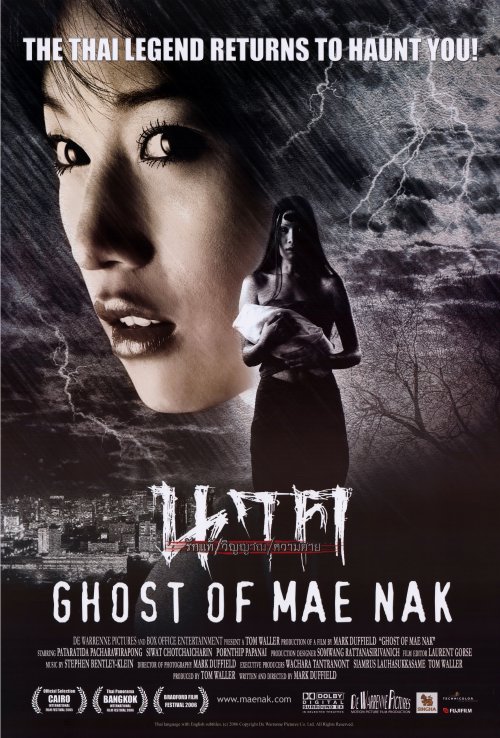
The legend of Mae Nak’s ghost has served as the basis for films in Thailand over 20 times, and this ghost story seems to be as popular there as the one about the vanishing hitchhiker is in America. It's the story of young newlyweds who find the early days of their marriage disrupted by a vengeful spirit.
Mak (Siwat Chotchaicharin) loves Nak (Pataratida Pacharawirapong), and vice versa. They chant this refrain to each other frequently, but it doesn’t play as cutesy as it sounds like it would because they really seem to mean it. The film tends to play just a notch or two beyond the point of reality for western viewers—reactions are a little too big and some of the dialogue seems to be delivered too broadly, but this may be the norm in Thai cinema, as it is in Bollywood films.
We meet the two a week before their wedding. They’ve seen an ad in the newspaper for a house for sale and they meet with the real estate agent, Mr. Angel (Meesak Nakarat), who tells them the house is over 100 years old. The lovers like and trust Mr. Angel, but then they trust their lawyer, too. Obviously, folks in Bangkok are a little different than we are in this country.
As they inspect the house, Mak has a brief but frightening encounter with what is surely a ghost. Her appearance is preceded by the sound of a breathy sigh, like Joan Jett singing “Crimson and Clover.” Worse yet, Mak’s been having nightmares about this same vaporous woman. The waking sight of her unnerves him, but not to the point of disappointing Nak, who really wants to buy the place.
They buy it, fix it up, and move in.
After the wedding takes place, eerie visitations and frightening nightmares increase, but now Nak is experiencing them as well. She hears the name “Mae Nak” and mentions it to her grandmother. Granny tells her Mae Nak’s back story.
Around 100 years ago, a couple who loved each other very much married. Their names were Mak and Nak. Mak went away to war and was seriously wounded. Some monks nursed him back to health and he returned to his home. While he was gone, Nak (Porntip Papanai) gave birth to their child. They were happy together, but Mak couldn’t understand why his old friends avoided visiting with him at home.
I’ve probably already told you too much, so I’ll only say from this point on in the film writer/director Mark Duffield picks up the pace considerably as the ghost woman goes after everyone in the modern couple’s life who does anything to come between them. Duffield even tosses in a couple a gruesome death scenes that should bring a cold smile to the lips of even the most jaded western gorehounds.
There’s a nice scene in an operating room that is at once both surprising and silly, but it works because we’ve become used to the slightly overwrought feel of the entire film. I could do without the head-beating of having both sets of lovers bear the same names, but the film isn’t going for subtlety.
There are no overwhelming scares in the movie, but there is a building tension. If the first half of the picture intrigues with its moments of everyday life in an exotic setting, the second half ladles on a creepy disquiet that culminates in a kick ass ending you won’t see coming.
“The Ghost of Mae Nak” is a nifty ghost story that may burrow deepest under the skin of people who think that ghosts, and ghost stories, are silly. It asks, along with Poe, “Is all that we see or seem / But a dream within a dream?” and answers, “I’ll let you know when I wake up. If I wake up.”
Mak (Siwat Chotchaicharin) loves Nak (Pataratida Pacharawirapong), and vice versa. They chant this refrain to each other frequently, but it doesn’t play as cutesy as it sounds like it would because they really seem to mean it. The film tends to play just a notch or two beyond the point of reality for western viewers—reactions are a little too big and some of the dialogue seems to be delivered too broadly, but this may be the norm in Thai cinema, as it is in Bollywood films.
We meet the two a week before their wedding. They’ve seen an ad in the newspaper for a house for sale and they meet with the real estate agent, Mr. Angel (Meesak Nakarat), who tells them the house is over 100 years old. The lovers like and trust Mr. Angel, but then they trust their lawyer, too. Obviously, folks in Bangkok are a little different than we are in this country.
As they inspect the house, Mak has a brief but frightening encounter with what is surely a ghost. Her appearance is preceded by the sound of a breathy sigh, like Joan Jett singing “Crimson and Clover.” Worse yet, Mak’s been having nightmares about this same vaporous woman. The waking sight of her unnerves him, but not to the point of disappointing Nak, who really wants to buy the place.
They buy it, fix it up, and move in.
After the wedding takes place, eerie visitations and frightening nightmares increase, but now Nak is experiencing them as well. She hears the name “Mae Nak” and mentions it to her grandmother. Granny tells her Mae Nak’s back story.
Around 100 years ago, a couple who loved each other very much married. Their names were Mak and Nak. Mak went away to war and was seriously wounded. Some monks nursed him back to health and he returned to his home. While he was gone, Nak (Porntip Papanai) gave birth to their child. They were happy together, but Mak couldn’t understand why his old friends avoided visiting with him at home.
I’ve probably already told you too much, so I’ll only say from this point on in the film writer/director Mark Duffield picks up the pace considerably as the ghost woman goes after everyone in the modern couple’s life who does anything to come between them. Duffield even tosses in a couple a gruesome death scenes that should bring a cold smile to the lips of even the most jaded western gorehounds.
There’s a nice scene in an operating room that is at once both surprising and silly, but it works because we’ve become used to the slightly overwrought feel of the entire film. I could do without the head-beating of having both sets of lovers bear the same names, but the film isn’t going for subtlety.
There are no overwhelming scares in the movie, but there is a building tension. If the first half of the picture intrigues with its moments of everyday life in an exotic setting, the second half ladles on a creepy disquiet that culminates in a kick ass ending you won’t see coming.
“The Ghost of Mae Nak” is a nifty ghost story that may burrow deepest under the skin of people who think that ghosts, and ghost stories, are silly. It asks, along with Poe, “Is all that we see or seem / But a dream within a dream?” and answers, “I’ll let you know when I wake up. If I wake up.”
The Screaming Skull (1958)
When your thing is horror movies, you think often about that oddball breed of cinema we know as “cult
movies,” or “guilty pleasures.” I’m one of those people who don’t
usually use the latter term because if I enjoy a movie I don’t see any
reason I should feel guilty about it. Hell, if I felt the need to
apologize every time I enjoyed The Lost Skeleton of Cadavra or a
Wheeler and Woolsey comedy, I’d be more weighed down by guilt than Judas
Iscariot wearing an SS uniform while clubbing baby seals with a burning
cross.
Actually, not all guilty pleasures are cult movies. To be a cult movie, a picture has to be appreciated by a number of people and is generally thought to be “so bad it’s good,” making cult movies at least a subset of camp. Guilty pleasures—or as I like to call them, “what I watch on Friday nights”—may be totally unrecognized by others and don’t have to have any redeeming qualities whatsoever beyond the perhaps perverse pleasure they provide for me personally.
I’ve thought many times about how much I enjoy writing—part reviews, part criticisms, part appreciations, part apologetics—on the movies that exist closer to the bottom of the cinematic barrel in hopes of scamming, uh, encouraging you to cultivate your inner movie slob. No, seeing every new Adam Sandler movie on its first weekend of release doesn’t count. That’s just conformist bad taste and I know you can do better than that.
You can tell which schlockfest “B” horror movies manipulate the basic accoutrements of the genre best by the degree to which they scare the bejeezus out of small children, and one of the things that has great power to create a seat-wetting problem is the human skull. You don’t even have to give the ridges over the eyes that Harryhausen touch to make them look more sinister, but it can’t hurt.
Let’s begin 50 years ago, at childhood, that time in life when a person’s tastes—good and bad—are formed. The theater is The State, on the square of the small Texas town in which I grew up. The State played “B” movies and, on Saturday mornings, pictures in Spanish for the farm workers who came into the city for a few hours. But what I loved there best were horror movies like this one …
I'd just turned nine when I saw The Screaming Skull for the first time, and it scared the breath out of me. Fifty years later I can still remember being so frightened I couldn’t yell. Ah, those were great times … Macabre came along later that same year, with House on Haunted Hill and The Tingler (both 1959) soon to follow. We adolescent horror hounds, readers of “Famous Monsters of Filmland” all, were convinced that William Castle was the greatest filmmaker of all time. Even Psycho (1960) couldn’t pull us away as it was a little too adult—but we still read everything by Robert Bloch we could get our sweaty little hands on.
I don’t know if journeyman actor Alex Nicol, who directed The Screaming Skull in an effort to expand his career possibilities, could have beaten Castle into our hearts had he continued to make shockers. (Can you imagine a grown man still considering such a question? Neither can I.)
I’ve re-visited TSS several times over the decades. It used to show up on late night TV with some regularity, until even the tube outgrew such hack work, and more than one DVD distributor carries it in the catalogue. No, the original fear is long gone—I wish I knew a nine-year old I could convince to watch it in a dark room just to check out the reaction—but the memory is intact.
In the film, a newly wed couple come to the house the groom lived in with his former wife, the haunting Marion, who died in a sudden thunderstorm when she slipped on a wet leaf and stumbled by the lily pond, cracking her head open on a stone wall and then drowning. I’d think that this plot construct was an accidental reference to Ibsen’s Rosmersholm except for the fact that composer Ernest Gold—yes, the same man who would win an Oscar for scoring Exodus in 1960—borrows the same brooding Sabbat theme from Berlioz’ Symphonie Fantastique Stanley Kubrick used in The Shining (1980).
Maybe this movie is smarter than it has any right to be. John Kneubuhl, who would later write the “Pigeons From Hell” episode of Boris Karloff’s TV program Thriller, wrote the script based on the legend of the screaming skull of Bettiscomb Manor, in England.
But setting references to classier stuff aside, Eric and Jenni Whitlock attempt to settle into the house. As he introduces her to the grounds, Jenni spots a small outbuilding and asks what it is.
“That’s where Mickey keeps his gardening things,” Eric replies.
“Who’s Mickey?”
“The gardener.”
Or maybe the movie isn’t any smarter than it has to be. But you know that feeling you sometimes get, the feeling that the filmmakers are playing around a little because they know the kids that make up their audience aren’t going to get it, anyway? TSS engenders that feeling often.
Soon, Marion’s great friends, Reverend and Mrs. Snow, drop by for dinner and via some pretty unsubtle dialogue we learn that a) Mickey is still devoted to Marion and thinks her ghost haunts the house and grounds, b) Jenni had a nervous breakdown and was committed to a sanitarium when her parents were killed in an automobile accident, c) she is wealthy, and d) John Hudson, as Eric, is either the most ham-handed actor of the 1950s or he has been directed to make it clear to even the most naïve members of the audience that he wants to gain control of his new wife’s fortune.
Later that night, Jenni awakens to discover that Eric is missing, a window is banging in the wind, and Marion ’s self-portrait looks creepy in the moonlight. The next night, this scenario is replayed, only this time Jenni finds a skull in a cabinet. She tosses it out the window, but on her way back to bed she hears a knocking on the door and, yes, it turns out to be the skull.
It’s not much of a spoiler to admit that Eric is behind all the, uh, skullduggery, but whether or not there is a real ghost on his trail I will leave to you to discover for yourself. If you’ve ever read a pulp magazine weird menace story, or watched an episode of “Scooby-Doo,” you’ll have no trouble figuring out the late night mumbo-jumbo.
Hudson, who was Capt. Hobart in G.I. Blues (1960) and Virgil Earp in Gunfight at the O.K. Corral (1957) was certainly a better actor than this script calls for, and I suspect he was playing the evil genius with deadpan irony. Peggy Webber, as Jenni, looks a bit too robust to make a convincing Mrs. de Winter clone. Like almost every other actor in the film, she found her greatest success on TV. Leading roles in movies were out of the question—bless her, she looks like Nicholas Cage in drag, but with heftier boobs.
Russ Conway, who had unremarkable roles in What Ever Happened to Baby Jane? (1962) and The St. Valentine’s Day Massacre (1967) gives Rev. Snow a quiet, patient demeanor even though he looks fit enough to beat the crap out of Eric. Tony Johnson, as his wife, has no other credits on IMDB.
Director Alex Nicol, who plays Mickey, will be better remembered from his small roles in movies, including The Man from Laramie (1955). He later went to Europe to take part in the spaghetti western boom, coming home for a turn as George Barker in Roger Corman’s Bloody Mama in 1970.
In TSS he shows a nice camera eye for the clichés of the genre. His camera roams the empty halls of the house, creeping up on certain doors and importing to them a sense of dread that makes us both want to enter and run screaming away. I suspect that the movie would still work its dark magic on young kids, but many of them would be repelled by the questionable acting and black and white photography.
The film exists as a link between gothic chapbooks, dime novels, spooky radio shows, the pulp horror magazines and EC comics, and TV horror shows like Thriller and The Twilight Zone. Moments in it seem to have influenced Freddie Francis’ The Skull (1965), which, since it was based on a story by Robert Bloch, takes us back to where we started.
The Screaming Skull can’t possibly scare adults, and unless you saw it when you were young it won’t have any nostalgia appeal. But honestly, I’ve known several grown-ups who did see it back in the day, and they all remember it fondly as one of the scariest movies they’ve ever seen. Maybe we should let it go at that.
Actually, not all guilty pleasures are cult movies. To be a cult movie, a picture has to be appreciated by a number of people and is generally thought to be “so bad it’s good,” making cult movies at least a subset of camp. Guilty pleasures—or as I like to call them, “what I watch on Friday nights”—may be totally unrecognized by others and don’t have to have any redeeming qualities whatsoever beyond the perhaps perverse pleasure they provide for me personally.
I’ve thought many times about how much I enjoy writing—part reviews, part criticisms, part appreciations, part apologetics—on the movies that exist closer to the bottom of the cinematic barrel in hopes of scamming, uh, encouraging you to cultivate your inner movie slob. No, seeing every new Adam Sandler movie on its first weekend of release doesn’t count. That’s just conformist bad taste and I know you can do better than that.
You can tell which schlockfest “B” horror movies manipulate the basic accoutrements of the genre best by the degree to which they scare the bejeezus out of small children, and one of the things that has great power to create a seat-wetting problem is the human skull. You don’t even have to give the ridges over the eyes that Harryhausen touch to make them look more sinister, but it can’t hurt.
Let’s begin 50 years ago, at childhood, that time in life when a person’s tastes—good and bad—are formed. The theater is The State, on the square of the small Texas town in which I grew up. The State played “B” movies and, on Saturday mornings, pictures in Spanish for the farm workers who came into the city for a few hours. But what I loved there best were horror movies like this one …
I'd just turned nine when I saw The Screaming Skull for the first time, and it scared the breath out of me. Fifty years later I can still remember being so frightened I couldn’t yell. Ah, those were great times … Macabre came along later that same year, with House on Haunted Hill and The Tingler (both 1959) soon to follow. We adolescent horror hounds, readers of “Famous Monsters of Filmland” all, were convinced that William Castle was the greatest filmmaker of all time. Even Psycho (1960) couldn’t pull us away as it was a little too adult—but we still read everything by Robert Bloch we could get our sweaty little hands on.
I don’t know if journeyman actor Alex Nicol, who directed The Screaming Skull in an effort to expand his career possibilities, could have beaten Castle into our hearts had he continued to make shockers. (Can you imagine a grown man still considering such a question? Neither can I.)
I’ve re-visited TSS several times over the decades. It used to show up on late night TV with some regularity, until even the tube outgrew such hack work, and more than one DVD distributor carries it in the catalogue. No, the original fear is long gone—I wish I knew a nine-year old I could convince to watch it in a dark room just to check out the reaction—but the memory is intact.
In the film, a newly wed couple come to the house the groom lived in with his former wife, the haunting Marion, who died in a sudden thunderstorm when she slipped on a wet leaf and stumbled by the lily pond, cracking her head open on a stone wall and then drowning. I’d think that this plot construct was an accidental reference to Ibsen’s Rosmersholm except for the fact that composer Ernest Gold—yes, the same man who would win an Oscar for scoring Exodus in 1960—borrows the same brooding Sabbat theme from Berlioz’ Symphonie Fantastique Stanley Kubrick used in The Shining (1980).
Maybe this movie is smarter than it has any right to be. John Kneubuhl, who would later write the “Pigeons From Hell” episode of Boris Karloff’s TV program Thriller, wrote the script based on the legend of the screaming skull of Bettiscomb Manor, in England.
But setting references to classier stuff aside, Eric and Jenni Whitlock attempt to settle into the house. As he introduces her to the grounds, Jenni spots a small outbuilding and asks what it is.
“That’s where Mickey keeps his gardening things,” Eric replies.
“Who’s Mickey?”
“The gardener.”
Or maybe the movie isn’t any smarter than it has to be. But you know that feeling you sometimes get, the feeling that the filmmakers are playing around a little because they know the kids that make up their audience aren’t going to get it, anyway? TSS engenders that feeling often.
Soon, Marion’s great friends, Reverend and Mrs. Snow, drop by for dinner and via some pretty unsubtle dialogue we learn that a) Mickey is still devoted to Marion and thinks her ghost haunts the house and grounds, b) Jenni had a nervous breakdown and was committed to a sanitarium when her parents were killed in an automobile accident, c) she is wealthy, and d) John Hudson, as Eric, is either the most ham-handed actor of the 1950s or he has been directed to make it clear to even the most naïve members of the audience that he wants to gain control of his new wife’s fortune.
Later that night, Jenni awakens to discover that Eric is missing, a window is banging in the wind, and Marion ’s self-portrait looks creepy in the moonlight. The next night, this scenario is replayed, only this time Jenni finds a skull in a cabinet. She tosses it out the window, but on her way back to bed she hears a knocking on the door and, yes, it turns out to be the skull.
It’s not much of a spoiler to admit that Eric is behind all the, uh, skullduggery, but whether or not there is a real ghost on his trail I will leave to you to discover for yourself. If you’ve ever read a pulp magazine weird menace story, or watched an episode of “Scooby-Doo,” you’ll have no trouble figuring out the late night mumbo-jumbo.
Hudson, who was Capt. Hobart in G.I. Blues (1960) and Virgil Earp in Gunfight at the O.K. Corral (1957) was certainly a better actor than this script calls for, and I suspect he was playing the evil genius with deadpan irony. Peggy Webber, as Jenni, looks a bit too robust to make a convincing Mrs. de Winter clone. Like almost every other actor in the film, she found her greatest success on TV. Leading roles in movies were out of the question—bless her, she looks like Nicholas Cage in drag, but with heftier boobs.
Russ Conway, who had unremarkable roles in What Ever Happened to Baby Jane? (1962) and The St. Valentine’s Day Massacre (1967) gives Rev. Snow a quiet, patient demeanor even though he looks fit enough to beat the crap out of Eric. Tony Johnson, as his wife, has no other credits on IMDB.
Director Alex Nicol, who plays Mickey, will be better remembered from his small roles in movies, including The Man from Laramie (1955). He later went to Europe to take part in the spaghetti western boom, coming home for a turn as George Barker in Roger Corman’s Bloody Mama in 1970.
In TSS he shows a nice camera eye for the clichés of the genre. His camera roams the empty halls of the house, creeping up on certain doors and importing to them a sense of dread that makes us both want to enter and run screaming away. I suspect that the movie would still work its dark magic on young kids, but many of them would be repelled by the questionable acting and black and white photography.
The film exists as a link between gothic chapbooks, dime novels, spooky radio shows, the pulp horror magazines and EC comics, and TV horror shows like Thriller and The Twilight Zone. Moments in it seem to have influenced Freddie Francis’ The Skull (1965), which, since it was based on a story by Robert Bloch, takes us back to where we started.
The Screaming Skull can’t possibly scare adults, and unless you saw it when you were young it won’t have any nostalgia appeal. But honestly, I’ve known several grown-ups who did see it back in the day, and they all remember it fondly as one of the scariest movies they’ve ever seen. Maybe we should let it go at that.
Friday, May 8, 2015
“The Incredible Dr. Markesan” (1962)
Some things stick with you. Fifty years later I can still
remember an episode of The General
Electric Theater that scared the bejabers out of me (it was a ghost story
and when the young heroine got into bed and comfied up, the covers began to
slip down her figure as if being pulled from the bottom). Then there was “An Unlocked Window” on The Alfred Hitchcock Hour in 1965. The
one with the serial killer who specialized in a certain kind of woman. “You’re such a pretty nurse.” Writer James
Bridges won an Edgar Award for the script.
The third leg in my childhood Triple Crown is “The
Incredible Dr. Markesan” from Thriller.
Originally broadcast on February 26, 1962, “Markesan” summed up the chilling
delights of old school, black and white filmed horror.
Thriller was an
anthology program that lasted a mere two years on NBC. It’s said now that when
Hitchcock moved his show from CBS to NBC the competition from Thriller got a little too warm and he
was instrumental in its cancellation. Maybe so.
Thriller’s host
was Boris Karloff who, frequently, went a little too over the top. His
introduction to “Markesan” comes dangerously close to pure ham, but since he
was introducing himself as actor in the play (he appeared in only five stories
during the show’s brief run), he can be forgiven for chewing a little scenery.
He’s Dr. Konrad Markesan, retired (or was it fired?) from his
job in the science department of the local university. His once beautiful home
has run to ruin and he lives alone. His nephew Fred (Dick York) and Fred’s wife
Molly (Carolyn Kearney) come to see him hoping that he will give them a place
to stay while they look for jobs at the university. Markesan agrees,
unwillingly, with the proviso that they stay in their room after dark and not
go roaming around the house. To assure their compliance, the old man locks them
in at dusk.
I don’t want to give away too much since the entire Thriller run is now available on DVD and
you might get to see it, but know that the young couple’s curiosity gets the
better of them, especially when Fred sees his uncle hosting a bizarre meeting
in the library with three of his former colleagues, one of whom, he learns from
an old newspaper, died several years ago. As did Uncle Konrad. (Richard Hale as
the late Professor Latimore is magnificently creepy.)
Karloff, as you might expect, steals the show as the dusty, disheveled,
rambling Dr. Markesan. Long pauses fit in between questions from Fred and his
answers, and his smile is a hideous reminder of Conrad Veidt’s in The Man Who Laughs. It’s the forced
smile of a dirty old man—literally, a dirty old man. Markesan is easily among
the most sinister of Karloff’s later creations. The man is just not right.
Robert Florey directs with full-on Expressionist vigor. He
gets such good work from Karloff, it makes you wonder what Frankenstein would have been like with him at the controls.
(Although Florey, who was attached to the film before James Whale, wanted to
use Bela Lugosi as the Creature.)
Benjamin H. Kline is the director of photography and Howard
E. Johnson is the art director, both men doing superb work in making this look
like a Universal horror picture from the early 1930s. Morton Stevens’ music is
all strings, sighing and sobbing, and Jack Barron’s makeup work is a lot better
than you’d expect from 50 year old television. The script is by Donald S.
Sanford from a 1934 Weird Tales short
story by August Derleth and Mark Schorer.
The film is in gothic overdrive from beginning to end, with
a last shot (the one that creeped me out when I was 13 years old) that could
have been lifted from one of E.C.’s horror comics.
This is one vintage TV play that still pulls the plow. If
you’ve no fondness for the good old stuff “The Incredible Dr. Markesan” may
come across to you as campy. Too bad for you.
Sunday, April 26, 2015
Tourist Trap (1979)
I once heard on the radio a couple of guys chatting about classical
music. One of them said that people frequently ask him to name his favorite
composer, and he replies “Do you mean just real music or can I include Elgar?”
In the world of
film-lovers this kind of thing is covered by the term “guilty pleasure,” by
which is understood to mean those movies which have little if any recognizable
artistic merit, but we love them anyway. Not just watch with pleasure—love.
Personally, I’m not big into the concept of guilty pleasure because I hate having to offer explanations or, even worse, make excuses for spending time at the bottom of the “B” movie barrel. That stuff is not all I watch, but I do find myself down there with more frequency as I age. I think that’s because a) my taste has widened—and I hope deepened, but I’m not making any bets, b) I like looking for the wee bits of gold among the dross, and c) many of these films can be connected to my childhood years, when I first discovered the joys of watching movies and everything was grist for the mill.
Which brings me, finally, to a throw-away horror picture from 1979—well past the years of my childhood, alas—called Tourist Trap. It began life as a 30-minute student film by director David Schmoeller (Crawlspace, 1986; Puppet Master, 1989) at the University of Texas. The Texas Chain Saw Massacre was only five years old then and my guess is that many film students at UT hoped to strike another vein of Lone Star horror gold.
The feature version of the film stars Chuck Connors, an actor born to work in TV and “B” pictures, as Mr. Slausen, proprietor of a wax museum that has been bypassed by the new highway. His younger brother, Davy, was the sculptor, but Slausen tells us that he lives alone and that the large house behind the museum is now empty.
Who’s he talking to? A carload of young adults who have taken a wrong turn, had a flat, and are now looking for help. Woody (Keith McDermott), whose face opens the film, is seen rolling the flat down the road—you could be forgiven for thinking that Woody is returning to his car with the tire repaired as it appears to be all aired up—to Slausen’s combo museum/gas station/café. But no one is there.
Woody enters the café and, looking for help, enters the back room. The door slams shut behind him. It’s locked. He crosses to an open window only to have it slam down and lock. A mannequin crashes through the other window. What appears to be someone asleep on a cot turns out to be another mannequin, this one rising up to laugh at him. Things start flying around the room. This cacophony of action and noise ends when a piece of pipe hits Woody, inserting itself into his back. Suddenly, the only sound we hear is the blood running through the pipe and dripping onto the floor.
This occurs at the five-minute mark. Schmoeller and screenwriter J. Larry Carroll waste no time with set-up or exposition. They want to grab you by the hair, pull your head back, and put the blade to your throat before you’re comfortably in your seat. We have no idea who these kids are nor where they’re going, and we never come to care. We have the attachment to them we naturally have for attractive actors playing screen characters we know are victims, but as far as true empathy is concerned, forget it.
Soon Eileen (Robin Sherwood), the gal traveling with Woody, gets a ride with three friends in another car and they all end up at Slausen’s where they meet the man himself. He’s a big fella (Connors was 6’5”), he packs a shotgun and he’s a little on the eccentric side, but his speech and actions seem harmless. He invites them into the museum and promises to get his tools to help them when their Jeep stalls out.
Someone—either Slausen or an unknown person—appears to have telekinetic powers. The first clue that Davy may still be alive comes when Slausen tells his guests that his brother was a whiz with anything electrical and we assume that a clue to the “telekinesis” has been given to us. Could all the mysterious movement by inanimate objects be due to electronic jiggery-pokery? Or will it all turn out to be part of a shared insanity?
Not that it hasn’t already, but from here the plot follows a well-trod path. Slausen’s wife was a beauty and the joy of his life, but she died young. He has a wax figure of her that, when touched, feels as if it were covered by skin. Someone crazy is running around killing off the kids. It’s a tall man, say around 6’5”. He wears a plaster mask. Slausen says that it’s Davy. It all finally turns into a monster mash of Psycho, House of Wax, and the aforementioned TCSM.
The movie shows its influences clearly, but it’s just as obvious that it has inspired others as well. Spotting elements that will later turn up in the House of Wax remake and House of 1,000 Corpses is fairly easy. Schmoeller carried his animated mannequins over into Puppet Master. According to Henri Bergson, mechanical movement is supposed to be funny. I guess he was never stalked by a killer doll.
Personally, I find signs of life in inanimate objects to be pretty damn creepy, if not overdone to the point of Bergsonian chuckles. Michael Redgrave’s ventriloquist dummy in Dead of Night and the clown doll in Poltergeist are scary; Chucky is a hoot. This film is full of, and perhaps too full of, mannequins with moving eyes and whispering mouths. This surreal element is far creepier than the physical imperilment with which the lunatic threatens his victims.
The cast wanders back and forth across the line that divides competent performance from overwrought hackery. Connors, despite his stated desire to become the Boris Karloff of the 1980s, seems frequently to want to drop character and say “Come on, how can anyone take stuff like this seriously?”
Among the potential victims, Jocelyn Jones, daughter of character actor Henry Jones (he was the nasty maintenance man in The Bad Seed in 1956) is the best of the group as the mousy good girl. Jon Van Ness is Jerry, the guy who isn’t Woody, and Tanya Roberts, just barely pre-“Charley’s Angels,” is relatively convincing as Becky. Or maybe it’s just the shorts and tank top. Whatever, it works.
Tourist Trap is the creepiest—not scariest, but creepy is good, too—movie to come from producer Charles Band’s slush pile. Schmoeller knows what he’s doing and if this had been his third or fourth picture instead of his first, it would be a solid “B” classic. He has a good eye for the details that make a moment, as you’ll see in the last shot. Take a good look at the face of the person driving the jeep.
Personally, I’m not big into the concept of guilty pleasure because I hate having to offer explanations or, even worse, make excuses for spending time at the bottom of the “B” movie barrel. That stuff is not all I watch, but I do find myself down there with more frequency as I age. I think that’s because a) my taste has widened—and I hope deepened, but I’m not making any bets, b) I like looking for the wee bits of gold among the dross, and c) many of these films can be connected to my childhood years, when I first discovered the joys of watching movies and everything was grist for the mill.
Which brings me, finally, to a throw-away horror picture from 1979—well past the years of my childhood, alas—called Tourist Trap. It began life as a 30-minute student film by director David Schmoeller (Crawlspace, 1986; Puppet Master, 1989) at the University of Texas. The Texas Chain Saw Massacre was only five years old then and my guess is that many film students at UT hoped to strike another vein of Lone Star horror gold.
The feature version of the film stars Chuck Connors, an actor born to work in TV and “B” pictures, as Mr. Slausen, proprietor of a wax museum that has been bypassed by the new highway. His younger brother, Davy, was the sculptor, but Slausen tells us that he lives alone and that the large house behind the museum is now empty.
Who’s he talking to? A carload of young adults who have taken a wrong turn, had a flat, and are now looking for help. Woody (Keith McDermott), whose face opens the film, is seen rolling the flat down the road—you could be forgiven for thinking that Woody is returning to his car with the tire repaired as it appears to be all aired up—to Slausen’s combo museum/gas station/café. But no one is there.
Woody enters the café and, looking for help, enters the back room. The door slams shut behind him. It’s locked. He crosses to an open window only to have it slam down and lock. A mannequin crashes through the other window. What appears to be someone asleep on a cot turns out to be another mannequin, this one rising up to laugh at him. Things start flying around the room. This cacophony of action and noise ends when a piece of pipe hits Woody, inserting itself into his back. Suddenly, the only sound we hear is the blood running through the pipe and dripping onto the floor.
This occurs at the five-minute mark. Schmoeller and screenwriter J. Larry Carroll waste no time with set-up or exposition. They want to grab you by the hair, pull your head back, and put the blade to your throat before you’re comfortably in your seat. We have no idea who these kids are nor where they’re going, and we never come to care. We have the attachment to them we naturally have for attractive actors playing screen characters we know are victims, but as far as true empathy is concerned, forget it.
Soon Eileen (Robin Sherwood), the gal traveling with Woody, gets a ride with three friends in another car and they all end up at Slausen’s where they meet the man himself. He’s a big fella (Connors was 6’5”), he packs a shotgun and he’s a little on the eccentric side, but his speech and actions seem harmless. He invites them into the museum and promises to get his tools to help them when their Jeep stalls out.
Someone—either Slausen or an unknown person—appears to have telekinetic powers. The first clue that Davy may still be alive comes when Slausen tells his guests that his brother was a whiz with anything electrical and we assume that a clue to the “telekinesis” has been given to us. Could all the mysterious movement by inanimate objects be due to electronic jiggery-pokery? Or will it all turn out to be part of a shared insanity?
Not that it hasn’t already, but from here the plot follows a well-trod path. Slausen’s wife was a beauty and the joy of his life, but she died young. He has a wax figure of her that, when touched, feels as if it were covered by skin. Someone crazy is running around killing off the kids. It’s a tall man, say around 6’5”. He wears a plaster mask. Slausen says that it’s Davy. It all finally turns into a monster mash of Psycho, House of Wax, and the aforementioned TCSM.
The movie shows its influences clearly, but it’s just as obvious that it has inspired others as well. Spotting elements that will later turn up in the House of Wax remake and House of 1,000 Corpses is fairly easy. Schmoeller carried his animated mannequins over into Puppet Master. According to Henri Bergson, mechanical movement is supposed to be funny. I guess he was never stalked by a killer doll.
Personally, I find signs of life in inanimate objects to be pretty damn creepy, if not overdone to the point of Bergsonian chuckles. Michael Redgrave’s ventriloquist dummy in Dead of Night and the clown doll in Poltergeist are scary; Chucky is a hoot. This film is full of, and perhaps too full of, mannequins with moving eyes and whispering mouths. This surreal element is far creepier than the physical imperilment with which the lunatic threatens his victims.
The cast wanders back and forth across the line that divides competent performance from overwrought hackery. Connors, despite his stated desire to become the Boris Karloff of the 1980s, seems frequently to want to drop character and say “Come on, how can anyone take stuff like this seriously?”
Among the potential victims, Jocelyn Jones, daughter of character actor Henry Jones (he was the nasty maintenance man in The Bad Seed in 1956) is the best of the group as the mousy good girl. Jon Van Ness is Jerry, the guy who isn’t Woody, and Tanya Roberts, just barely pre-“Charley’s Angels,” is relatively convincing as Becky. Or maybe it’s just the shorts and tank top. Whatever, it works.
Tourist Trap is the creepiest—not scariest, but creepy is good, too—movie to come from producer Charles Band’s slush pile. Schmoeller knows what he’s doing and if this had been his third or fourth picture instead of his first, it would be a solid “B” classic. He has a good eye for the details that make a moment, as you’ll see in the last shot. Take a good look at the face of the person driving the jeep.
When you’re in the mood for schlocky “B” horror, you could do worse.
Tuesday, June 17, 2014
Odishon (Audition, 1999)
The story goes that when Ôdishon (Audition) played at the Rotterdam Film Festival in 2000 it scored a record number of walkouts. You’d think that the sadistic cruelty that was so upsetting in 2000 would be old hat by now, but the film is so well and smartly made it has lost none of its ability to make your lower jaw drop down and your fingers to dig deeply into the sofa cushion. And it’s not that the film is gory—you can enjoy more blood and guts in a standard episode of “C.S.I.”
No, in the case of this film, horror, thy name is intensity.
Ryo Ishibashi stars as Shigeharu Aoyama, a man who has been living a lonely life with his son since the death of his wife seven years ago. (Purists, please forgive me but I am writing Japanese names as if they were European, with the surname last.) The son, Shigehiko (Tetsu Sawaki) will soon be leaving home and suggests to his dad that he’s been single long enough. Shigeharu admits that he doesn’t even know how the dating game works anymore, but he is pleased by the fact that his son is aware of and cares about his lonliness.
Shigeharu visits with a friend, a man who works as a film producer. The producer comes up with a clever way for Shigeharu to meet young women: the two of them will pretend to be holding auditions for a new movie. They will interview dozens of potential date-mates, and Shigeharu can select the one he likes best and set up a time when they can meet. He frets about the shadiness of the idea’s morality, but ultimately agrees to try it.
Already, the film’s tone is odd. Not frightening yet—just odd. An air of melancholy hangs over what is essentially a romcom meet-cute situation.
Shigeharu is uncomfortable with every young woman he interviews until Asami Yamazaki (Eihi Shiina) shows up. She is slight, almost fragile looking. Pretty, quiet, respectful, she is everything an old school Japanese gentleman could wish for. At the conclusion of the interview, Shigeharu tells her that he will call soon to let her know his casting decision. When he does overcome his shame about his deceitfulness and phones her, she agrees to meet him. When they meet, he tells her the truth about the phony audition. She seems to like him for himself and he promises to call her again.
Later we see her sitting by the phone, waiting like a cat watching a mouse hole. A large filled and sealed canvas sack is visible on the floor by the phone. It could be Asami’s laundry, but we don’t think it is. It’s out of place, a surreal touch that sends a message about Asami. And it isn’t cheerful.
During a weekend tryst with Asami, Shigeharu begins to learn some disquieting things about her—she was a ballet student who had to quit dancing due to a hip injury; she was abused by her instructor.
After an afternoon of, we assume, sex, Shigeharu awakens to find that Asami has left. Back in town, the now completely smitten lover searches for the missing woman, and he discovers more and more of her past, which includes a murder by dismemberment. When the chopped-up body was investigated by the police, they uncovered three fingers and an ear too many. At Asami’s apartment we see that unsettling canvas sack moving and find out what it contains. Right. It isn’t dirty clothes.
Returning home, Shigeharu pours himself a drink then quickly falls to the floor paralyzed. Asami steps out of the shadows to inform that 1) the drug she gave him will prevent him from moving but not from being completely aware of what is happening to him and from feeling pain, and 2) the thin wire she shows him can cleanly cut through flesh and bone.
Working from a script by Daisuke Tengan, adapted from a novel by Ryû Murakami, director Takashi Miike has created one of the creepiest, most suspenseful horror films of the 1990s. Miike plays expertly with audience expectations, taking us right to the edge of what we expect to see only to suddenly shift the carpet under us so that we end up looking at things we never expected.
No list of great psycho thrillers will ever again be complete without Ôdishon close to the top. Don’t see it with someone you love—when it’s over, you won’t feel like you can trust her anymore.
No, in the case of this film, horror, thy name is intensity.
Ryo Ishibashi stars as Shigeharu Aoyama, a man who has been living a lonely life with his son since the death of his wife seven years ago. (Purists, please forgive me but I am writing Japanese names as if they were European, with the surname last.) The son, Shigehiko (Tetsu Sawaki) will soon be leaving home and suggests to his dad that he’s been single long enough. Shigeharu admits that he doesn’t even know how the dating game works anymore, but he is pleased by the fact that his son is aware of and cares about his lonliness.
Shigeharu visits with a friend, a man who works as a film producer. The producer comes up with a clever way for Shigeharu to meet young women: the two of them will pretend to be holding auditions for a new movie. They will interview dozens of potential date-mates, and Shigeharu can select the one he likes best and set up a time when they can meet. He frets about the shadiness of the idea’s morality, but ultimately agrees to try it.
Already, the film’s tone is odd. Not frightening yet—just odd. An air of melancholy hangs over what is essentially a romcom meet-cute situation.
Shigeharu is uncomfortable with every young woman he interviews until Asami Yamazaki (Eihi Shiina) shows up. She is slight, almost fragile looking. Pretty, quiet, respectful, she is everything an old school Japanese gentleman could wish for. At the conclusion of the interview, Shigeharu tells her that he will call soon to let her know his casting decision. When he does overcome his shame about his deceitfulness and phones her, she agrees to meet him. When they meet, he tells her the truth about the phony audition. She seems to like him for himself and he promises to call her again.
Later we see her sitting by the phone, waiting like a cat watching a mouse hole. A large filled and sealed canvas sack is visible on the floor by the phone. It could be Asami’s laundry, but we don’t think it is. It’s out of place, a surreal touch that sends a message about Asami. And it isn’t cheerful.
During a weekend tryst with Asami, Shigeharu begins to learn some disquieting things about her—she was a ballet student who had to quit dancing due to a hip injury; she was abused by her instructor.
After an afternoon of, we assume, sex, Shigeharu awakens to find that Asami has left. Back in town, the now completely smitten lover searches for the missing woman, and he discovers more and more of her past, which includes a murder by dismemberment. When the chopped-up body was investigated by the police, they uncovered three fingers and an ear too many. At Asami’s apartment we see that unsettling canvas sack moving and find out what it contains. Right. It isn’t dirty clothes.
Returning home, Shigeharu pours himself a drink then quickly falls to the floor paralyzed. Asami steps out of the shadows to inform that 1) the drug she gave him will prevent him from moving but not from being completely aware of what is happening to him and from feeling pain, and 2) the thin wire she shows him can cleanly cut through flesh and bone.
Working from a script by Daisuke Tengan, adapted from a novel by Ryû Murakami, director Takashi Miike has created one of the creepiest, most suspenseful horror films of the 1990s. Miike plays expertly with audience expectations, taking us right to the edge of what we expect to see only to suddenly shift the carpet under us so that we end up looking at things we never expected.
No list of great psycho thrillers will ever again be complete without Ôdishon close to the top. Don’t see it with someone you love—when it’s over, you won’t feel like you can trust her anymore.
Subscribe to:
Posts (Atom)